Talisman Sabre 2025
Military Signals from the Indo-Pacific
The Indo-Pacific remains the focal point of 21st-century strategic competition, and few events capture its military choreography better than the ongoing Talisman Sabre 2025 exercise. It began on 13th July and is scheduled to complete on 4th August. This year’s edition is the largest and most complex since the drills began in 2005. With over 35,000 personnel from 19 nations, including first-time host and participant Papua New Guinea, the scale of the operation reflects both growing anxiety over regional security and the urgent desire to demonstrate allied coordination in the face of rising geopolitical tensions.
Papua New Guinea’s inclusion is particularly notable. As China’s influence expands in the Pacific Islands through infrastructure, aid, and security agreements, the US and its partners are responding with deepening defence cooperation in the region. The decision to include PNG as both a participant and host adds a critical new node to the Indo-Pacific security lattice.
From Bilateral Drill to Multi-Domain Platform
First held in 2005 as a bilateral US–Australia military drill, Talisman Sabre has evolved into a sprawling, multilateral platform that now incorporates air, land, sea, cyber, and space operations. Each edition has mirrored shifts in global strategic concerns — from counterinsurgency to great-power rivalry. The 2025 version is no exception. With a focus on joint command structures, digital battlefields, and long-range precision strike capabilities, the exercise reflects a maturing defence coalition preparing for complex, multi-domain contingencies.
What Sets 2025 Apart
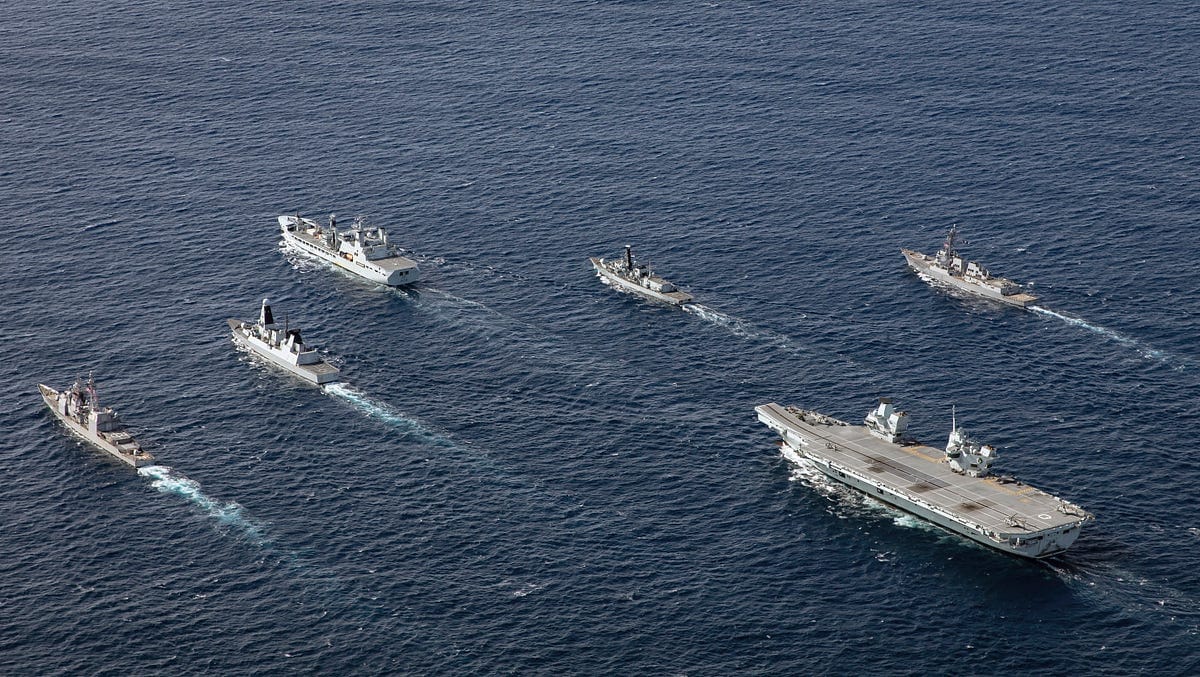
Several milestones distinguish the 2025 iteration. For the first time, the UK’s HMS Prince of Wales and the US Navy’s USS George Washington are participating simultaneously, symbolizing enhanced maritime reach and NATO–Pacific alignment. The first-ever deployment of the US Army’s Typhon missile system outside the continental US — culminating in a live-fire SM-6 launch — underscores the growing emphasis on distributed, mobile firepower.
In another first, a joint HIMARS battery involving US, Australian, and Singaporean forces conducted live-fire drills, exemplifying deep interoperability. The exercise also saw the establishment of a US–Australian Combined Air and Missile Defence Headquarters, a significant step toward integrated theatre-level planning. Perhaps most futuristic was the activation of the Multinational Information Operations Centre (MIOC), which coordinated joint cyber, electromagnetic spectrum, and narrative operations across participating forces.
Deterrence by Design
Though officially described as non-targeted and defensive, Talisman Sabre 2025 is widely interpreted as preparing for scenarios that resemble contingencies in the Taiwan Strait and South China Sea. The nature of the drills, including the long-range strike coordination, amphibious landings, and contested-domain operations, suggests planning for high-intensity conflicts in precisely those theatres.
The timing and composition send a message not just to adversaries but also to regional partners. The participation of France, Japan, India, the UK, and now PNG, alongside core allies, reinforces a shared commitment to a “rules-based Indo-Pacific order.” It reflects a growing consensus that regional security cannot be guaranteed by bilateral alliances alone but requires multilateral frameworks and visible readiness.
China has not remained silent. While official statements have downplayed the exercise, Chinese military commentators have noted its “provocative proximity” and “targeted symbolism.” Whether these are rhetorical flourishes or early signs of a calibrated response remains to be seen.
India’s Quiet Calculus
For India, participation in Talisman Sabre represents more than symbolic alignment. The visit of Air Marshal Ashutosh Dixit, Chief of Integrated Defence Staff, and his high-level meetings with Australian and US counterparts reflect India’s desire to deepen operational familiarity without formal alliance entanglements.
This aligns with India’s doctrine of being an “autonomous strategic actor” and a “net security provider” in the Indian Ocean and beyond. Participation in a planning capacity allows India to both contribute to and learn from joint operations without diluting its strategic autonomy. It also enables India to strengthen bilateral and trilateral ties — particularly with Australia and Japan — beyond the Quad framework.
Coalitions Without Alliances?
Talisman Sabre illustrates the rise of what some analysts call “coalitions of the willing” — flexible, mission-specific alignments that do not require formal treaty obligations. The US, UK, Australia, Japan, and India are increasingly practicing for coordinated action without waiting for NATO-style institutional convergence.
This model appeals to nations like India that prefer strategic fluidity over fixed alliances. At the same time, it raises questions for ASEAN, whose members must balance security partnerships with their preference for neutrality amid US–China competition.
The implicit presence of AUKUS also looms large. While not formally connected to Talisman Sabre, the shared technological and doctrinal themes — missile defence, cyber integration, joint command structures — point to deeper military integration across the Indo-Pacific.
Shaping Intent, Not Just Capability
Talisman Sabre 2025 may be remembered less for any single headline-grabbing event than for its cumulative effect on regional security perceptions. In a contested Indo-Pacific, these drills serve not only to hone capabilities but to shape the geopolitical imagination — of friends and rivals alike.
The real impact lies in the visible demonstration of intent: to deter aggression, uphold freedom of navigation, and offer smaller states an alternative security architecture. In this sense, exercises like Talisman Sabre are not the rehearsal for war but the performance of deterrence, where coordination, complexity, and continuity speak louder than rhetoric.
As the exercise nears its final phase, one message stands clear: readiness is not an act, but a habit — and in the Indo-Pacific, that habit is becoming a shared one.
#TalismanSabre2025 #IndoPacific #Geopolitics #IndiaAustralia #USIndia #AUKUS #Quad #MilitaryExercise #IndiaDefence #ChinaWatch #StrategicAffairs #DefenceDiplomacy #IndoPacificSecurity #TaiwanStrait #SouthChinaSea #IndiaInIndoPacific #SecurityCoalitions #RulesBasedOrder #IndianForeignPolicy #Multilateralism