Preah Vihear Dispute
Temple, Territory, and the Politics of Memory
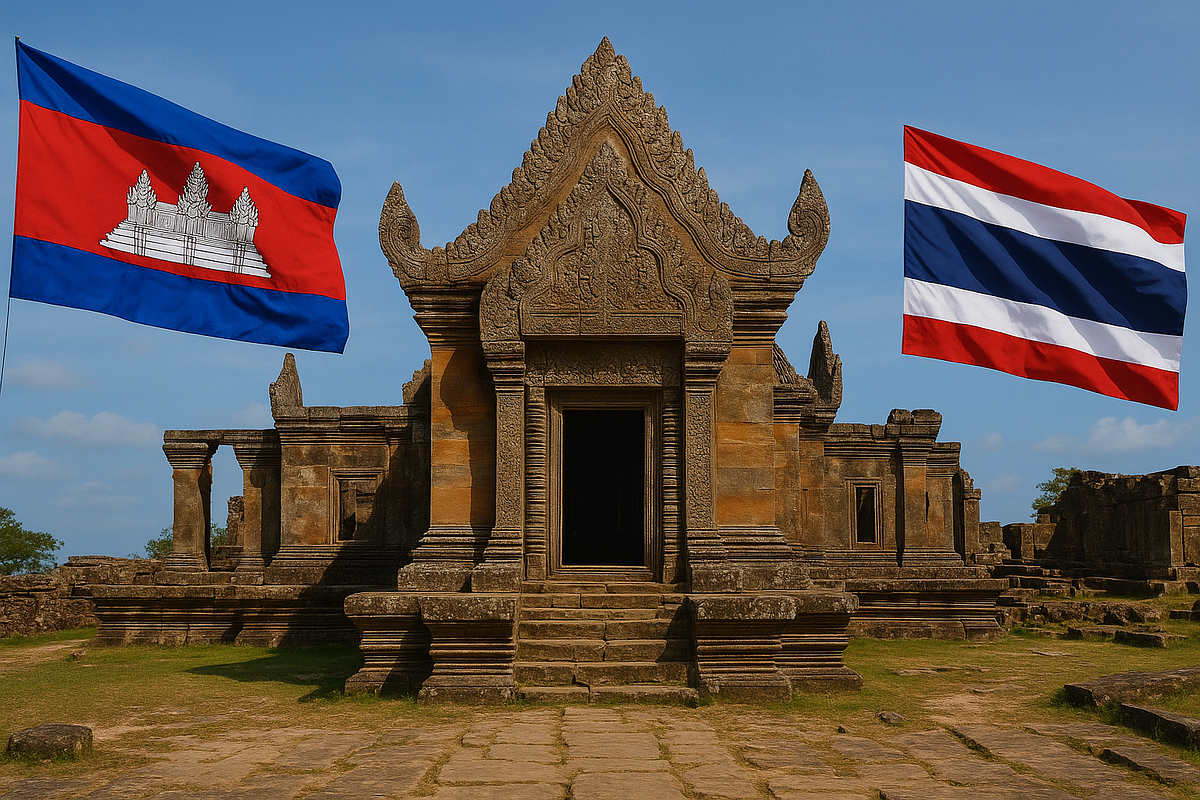
Two Buddhist-majority kingdoms in Southeast Asia, Thailand and Cambodia, are once again at odds over a 1,000-year-old Hindu temple perched atop a mountain on their disputed border. The Preah Vihear temple, dedicated to Lord Shiva and admired for its intricate Khmer architecture, has become the center of a geopolitical and nationalistic conflict that blends colonial history, international law, and regional rivalries. Though currently administered by Cambodia, the area surrounding the temple remains a point of contention, and recent skirmishes have reignited a long-dormant dispute between the two neighbours.
The latest flashpoint came in late May 2025, when a Cambodian soldier was reportedly killed during a brief exchange of fire near the Morokot border village. While both sides have blamed each other for initiating the incident, the underlying tensions run much deeper. For Thailand, the temple’s location on a promontory accessed more easily from Thai territory has long been a source of political and cultural grievance. For Cambodia, it remains a symbol of national pride and sovereignty, especially after international rulings in its favor.
Colonial Cartography and Legal Claims
The roots of the Preah Vihear dispute lie deep in the region’s colonial past. In the early 20th century, French colonial authorities in Indochina undertook the task of demarcating the boundary between Siam (modern-day Thailand) and Cambodia. A 1904 agreement stipulated that the border should follow the natural watershed line of the Dangrek Mountains. However, a French-made map from 1907 placed the Preah Vihear temple on the Cambodian side of the border — a discrepancy that Thailand did not formally object to at the time but later cited as grounds for dispute.
The matter remained dormant until the 1950s. After Cambodia gained independence from France, the temple became a focal point of territorial claims. In 1954, Thai forces occupied the temple, triggering a formal complaint from Cambodia, which eventually brought the case to the International Court of Justice (ICJ). In 1962, the ICJ ruled in Cambodia’s favor, declaring that the temple lay within Cambodian territory and ordering Thailand to withdraw its forces. Thailand complied, but resentment lingered, particularly concerning the adjacent lands surrounding the temple, which remained ambiguously defined.
Heritage Recognition and Renewed Tensions
The conflict resurfaced with renewed vigor in 2008, when Cambodia succeeded in having Preah Vihear listed as a UNESCO World Heritage Site. The move was seen by Cambodia as a recognition of the temple’s cultural and historical significance, but in Thailand, it was viewed as a unilateral act that undermined Thai claims to the adjacent land. Thailand protested the decision, and within months, military clashes erupted along the border. From 2008 to 2011, sporadic exchanges of gunfire and shelling killed dozens and displaced hundreds of civilians.
The violence prompted further legal action. In 2011, Cambodia again approached the ICJ, seeking a clarification of the 1962 judgment. In 2013, the Court reaffirmed Cambodia’s sovereignty over the temple. However, it did not explicitly resolve the status of the entire 4.6-square-kilometre disputed area, which allowed room for continuing disagreements and maintained the potential for future conflict.
Recent Skirmishes and Diplomatic Fallout
The May 2025 skirmish has brought the longstanding dispute back into the regional and international spotlight. Cambodian officials claimed that Thai troops had violated a tacit ceasefire by advancing into sensitive territory and opening fire. Thailand denied the allegations, stating that its troops acted in response to Cambodian provocations. While no escalation followed immediately, the incident prompted swift diplomatic responses and public statements from both governments aimed at reassuring domestic audiences while maintaining pressure on the international stage.
In response to the incident, Cambodia announced plans to submit a new petition to the ICJ, seeking a definitive ruling on the disputed land beyond the already adjudicated area. At the same time, Thailand has called for the resumption of bilateral talks through the Joint Boundary Commission (JBC), a mechanism that had been dormant for over a decade. The JBC met on 14 June 2025, in what both sides described as a constructive engagement. However, significant breakthroughs remain elusive, and each country continues to fortify its positions along the border.
Nationalism, Politics, and the Shadow of History
The Preah Vihear dispute cannot be fully understood without examining the domestic political contexts of both nations. In Thailand, the temple has often served as a rallying point for nationalist sentiments, particularly during times of political instability. Political parties and activist groups have used the issue to project strength, mobilize public opinion, and deflect attention from internal challenges. Cambodia has similarly leaned into the narrative of historical injustice, portraying the defense of the temple as a patriotic cause and a symbol of resistance against foreign encroachment.
These competing nationalisms tend to obscure the temple’s shared heritage. Built during the reign of the Khmer Empire, Preah Vihear embodies an era when the cultural and spiritual boundaries of Southeast Asia were more fluid than political maps suggest today. Both Cambodians and Thais share historical, linguistic, and religious ties to the site, but modern geopolitics has turned it into a flashpoint rather than a shared monument.
Cultural Symbolism and Local Realities
While diplomats and politicians argue over maps and legal texts, communities on the ground continue to live with the realities of the dispute. Villages on both sides of the border have faced multiple displacements over the years, with military presence and occasional violence disrupting agriculture, trade, and daily life. Infrastructure projects have been stalled, and the potential for tourism revenue remains largely untapped due to security concerns.
The UNESCO designation, while prestigious, has had a mixed impact. It brought international funding and attention to Preah Vihear’s preservation, but also intensified political claims. Cambodian authorities have undertaken restoration and conservation efforts with India’s support, but Thai officials have criticized what they perceive as unilateral control. Suggestions for joint management or heritage tourism cooperation have occasionally emerged but have struggled to gain traction amid mutual suspicion.
What Lies Ahead?
Looking ahead, the road to resolution remains complex and uncertain. A new ICJ ruling could provide much-needed legal clarity, but legal decisions alone are unlikely to resolve the deeply embedded political and emotional layers of the conflict. Successful resolution will depend on political will, sustained diplomacy, and perhaps most importantly, a shift in public narratives on both sides.
In a region that frequently speaks of ASEAN solidarity and integration, the Preah Vihear conflict stands as a sobering reminder of how unresolved colonial legacies can still derail regional harmony. As the ancient stones of Preah Vihear continue to weather the elements on the Dangrek cliffs, the temple remains more than a monument of the past. It is a living symbol of contested memory, a battleground of identity, and a mirror of the diplomatic maturity of Southeast Asia.
#Thailand #Cambodia #PreahVihear #TempleDispute #BorderConflict #SoutheastAsia #Geopolitics #ColonialHistory #InternationalLaw #ICJ #ASEAN #HinduTemples #Nationalism #TerritorialDisputes #CulturalHeritage #IndiaCambodiaRelations #HistoricalConflict #GlobalAffairs #Diplomacy #AncientTemples