Myanmar
A Nation in Turmoil
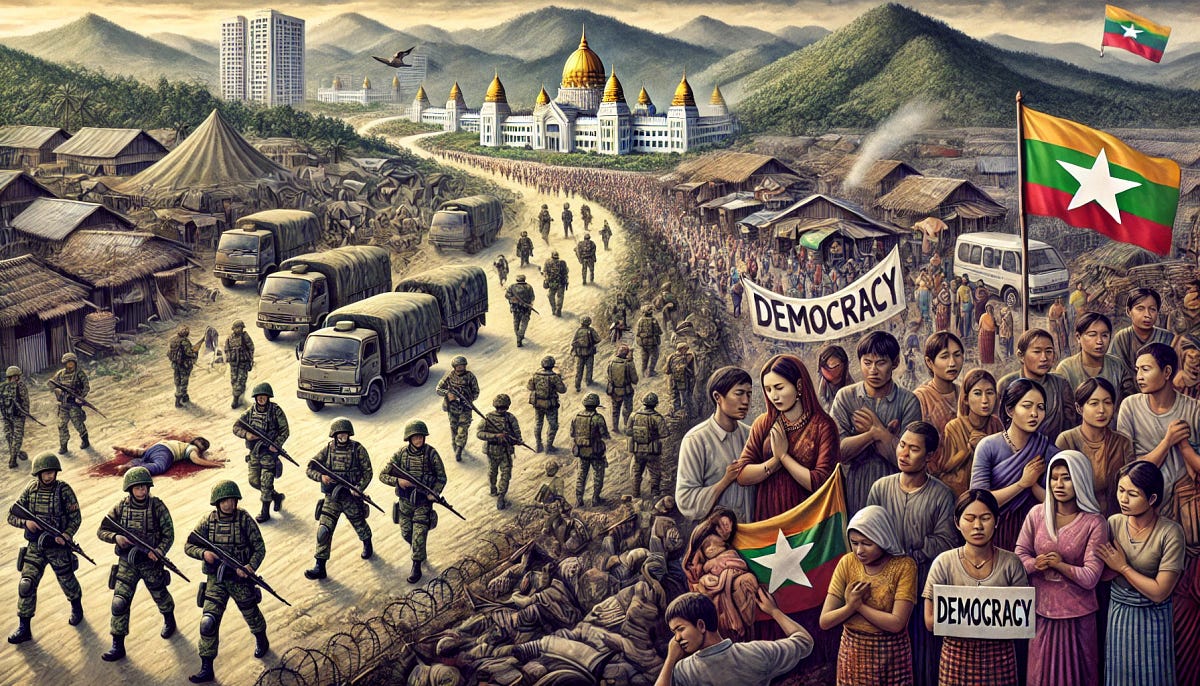
Myanmar, a nation in South East Asia with over 50 million people, has long been a land of both promise and turmoil. Rich in natural resources and strategically located between China, India, and Thailand, it holds geopolitical significance. However, Myanmar has also been a stage for decades of political unrest, ethnic tensions, and humanitarian crises. This article aims to provide a clear and neutral account of the current situation for those unfamiliar with its complexities.
Historical Background
Myanmar’s history is shaped by its colonial past and the challenges of a diverse nation navigating independence. Under British rule from the 19th century until 1948, the country — then called Burma — experienced significant economic and social changes. However, the divide-and-rule policies of the colonial administration exacerbated ethnic tensions that persist to this day.
After gaining independence, the nation faced immediate challenges, including internal conflicts among its numerous ethnic groups. In 1962, the military seized power, initiating decades of authoritarian rule. During this period, civil liberties were curtailed, and armed conflicts intensified between the central government and various ethnic groups seeking autonomy.
In 2010, Myanmar began a fragile transition toward democracy. The 2015 general elections brought hope for lasting civilian governance, with Aung San Suu Kyi’s National League for Democracy (NLD) party emerging victorious. Despite this, the military retained considerable power under the 2008 constitution, which guaranteed it 25% of parliamentary seats and control over key ministries.
The democratic experiment was short-lived, lasting only about five years. By 2021, Myanmar’s political landscape changed dramatically once again.
Key Drivers of the Current Crisis
The current crisis erupted in February 2021 when the military, known as Tatmadaw, staged a coup, claiming electoral fraud in the 2020 general elections. This coup led to the detention of civilian leaders, including Nobel laureate Aung San Suu Kyi, and the dissolution of democratic institutions. The military’s justification for the coup was met with widespread skepticism both domestically and internationally.
In response, the people of Myanmar launched a Civil Disobedience Movement (CDM), marked by mass protests, labor strikes, and calls for a return to civilian rule. These peaceful demonstrations were met with severe crackdowns, leading to reports of violence, mass arrests, and the displacement of civilians.
Compounding the political turmoil are long standing ethnic tensions. Myanmar is home to over 135 officially recognized ethnic groups, many of which have had strained relations with the central government. Armed groups representing these communities have waged decades-long struggles for greater autonomy or independence, particularly in border regions such as Kachin, Shan, and Rakhine states.
Humanitarian Impact
The impact of this crisis on ordinary citizens has been devastating. Thousands have been displaced, fleeing both the conflict zones and the oppressive measures of the military. Refugee flows into neighboring countries like Thailand, India, and Bangladesh have strained regional resources and heightened international concern.
Civilians bear the brunt of the violence. Reports from human rights organizations document widespread abuses, including arbitrary detentions, attacks on villages, and restrictions on humanitarian access. Humanitarian organizations have struggled to provide relief, often impeded by access restrictions and security concerns. Food insecurity and lack of medical aid are growing challenges, particularly in rural areas and displacement camps.
International Reactions
The global community has reacted with a mix of condemnation, sanctions, and diplomacy. Western nations, including the United States and members of the European Union, have imposed targeted sanctions on military leaders and their business interests. The United Nations has called for dialogue and a cessation of hostilities but faces limitations in enforcement.
In the region, ASEAN has taken the lead in mediating the crisis. However, the bloc’s principle of non-interference has complicated its efforts to achieve a unified response. Neighboring powers like China and India, with strategic interests in Myanmar, have tread cautiously, balancing their geopolitical aims with calls for stability. While China, as Myanmar’s largest investor, has emphasized stability to protect its economic projects, India has balanced its democratic values with strategic concerns over countering Chinese influence and ensuring security along its northeastern border.
Current Situation and Outlook
As of now, Myanmar remains in turmoil. The territorial control is divided, with the military maintaining dominance over urban centers such as Yangon, Mandalay, and Naypyidaw, while rural and border areas, including parts of Kachin, Shan, and Karen states, are influenced by ethnic armed organizations (EAOs) and the People’s Defense Force (PDF). These resistance groups control valuable assets like jade mines, timber reserves, and rare earth mining hubs, such as Kanpaiti on the Chinese border, providing both economic sustenance and strategic leverage. Armed clashes between the military and ethnic armed organizations continue, while civilian resistance persists in both urban and rural areas.
The economy has also been severely impacted by the ongoing conflict, with the World Bank projecting minimal growth and estimating that the economy remains 10% smaller than pre-pandemic levels. The Myanmar kyat has faced significant depreciation, resulting in hyperinflation and soaring prices for commodities like gold, which is becoming a critical store of value amidst the currency instability. Trade disruptions from border closures and conflict have also led to sharp declines in imports and exports, exacerbating shortages of critical goods.
The Path Ahead
The path to resolution is fraught with challenges. Myanmar’s complex ethnic landscape, coupled with deep mistrust between the military and civilian populations, complicates peace efforts. For a sustainable solution, any future agreement must address both the political crisis and the underlying ethnic grievances that have fueled decades of unrest.
While the immediate outlook appears grim, hope lies in continued international attention and pressure for inclusive dialogue. Myanmar’s future depends on balancing the aspirations of its diverse communities with the need for a stable and democratic governance structure.
The situation in Myanmar serves as a reminder of the intricate challenges faced by multi-ethnic nations undergoing political transitions. It is a crisis marked by human suffering, political deadlock, and the enduring struggle for autonomy and representation. For the global community, Myanmar’s plight demands not only humanitarian aid but also sustained efforts to facilitate dialogue and reconciliation.