Mongolia and France’s Landmark Uranium Agreement
A Geopolitical and Economic Turning Point
Introduction
Mongolia, a landlocked nation rich in mineral resources but geopolitically sandwiched between China and Russia, has taken a decisive step toward diversifying its economy and securing a place in the global nuclear energy market.
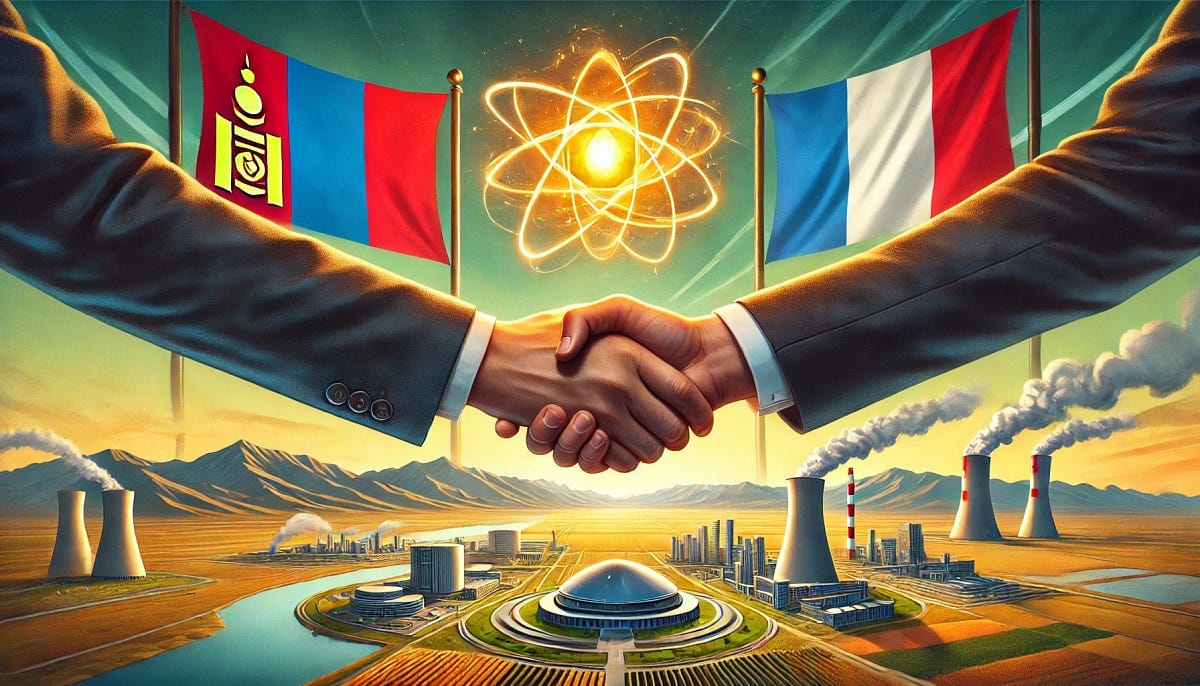
In a landmark move, Mongolia has entered into a $1.6 billion investment agreement with France to jointly develop the Zuuvch-Ovoo uranium mine. The deal, signed last month between France’s Orano Group and Mongolia’s state-owned MonAtom, is one of the most significant foreign direct investments in Mongolia’s energy sector in recent years.
For Mongolia, this agreement is more than an economic opportunity — it is a strategic decision to reduce its reliance on China, which currently dominates its exports. For France, securing access to Mongolia’s uranium reserves strengthens its position as a global leader in nuclear energy, ensuring long-term supply stability.
As both nations mark six decades of diplomatic ties, this agreement stands as a defining moment in their evolving relationship.
Strengthening Mongolia-France Relations
Diplomatic relations between Mongolia and France date back to 1965, but their engagement has often been overshadowed by Mongolia’s economic dependence on its two powerful neighbors. Historically, France has played a supportive role in Mongolia’s efforts to integrate with the broader international community. It has promoted economic cooperation, educational exchanges, and governance initiatives, seeing Mongolia as a potential partner in a strategically significant region.
However, Mongolia’s mining sector has long been dominated by Chinese investments, with more than 80 percent of the country’s exports flowing to China. With this new uranium deal, Mongolia is signaling a shift in its foreign policy strategy, seeking stronger ties with Western democracies. This move aligns with Mongolia’s “Third Neighbor” policy, an effort to balance the country’s economic and political relationships by engaging with nations beyond China and Russia.
The Details of the Uranium Agreement
The Zuuvch-Ovoo uranium mine, located in Mongolia’s Dornogovi Province, is a significant site with large reserves of uranium, a resource critical for nuclear energy production. The agreement between Orano, a French nuclear energy multinational, and MonAtom, Mongolia’s nuclear energy agency, sets the stage for large-scale uranium extraction, technological collaboration, and infrastructure development.
The project, once operational, is expected to provide about 1600 direct and indirect jobs in Mongolia and introduce advanced mining technologies from France, setting new standards for safety and efficiency. Moreover, the deal ensures that Mongolia will not only supply uranium to France’s nuclear industry but also benefit from foreign expertise, helping the country develop its nuclear energy capabilities for potential future domestic use.
Mongolia has long struggled with foreign direct investment volatility, often due to fluctuating mining policies and environmental concerns. This agreement with France signals to the global business community that Mongolia is open for investment, potentially attracting more Western companies into the country’s resource sector.
Economic and Geopolitical Implications
For Mongolia, this agreement represents a path toward economic diversification. Despite being rich in coal, copper, and gold, the country remains highly dependent on China as its primary export market. By expanding into uranium and forging ties with a Western partner, Mongolia is reducing its vulnerability to economic coercion from its powerful neighbors.
The deal also enhances Mongolia’s geopolitical standing, as it strengthens ties with a European power at a time when global competition for energy resources is intensifying. The uranium market is experiencing a revival, driven by rising demand for nuclear energy as nations look for cleaner alternatives to fossil fuels. With countries like France pushing forward with ambitious nuclear energy strategies, Mongolia has found a high-value export that ensures long-term economic benefits.
For France, the agreement is equally significant. As one of the world’s largest producers of nuclear energy, France relies heavily on stable uranium supplies. With its domestic mines long depleted, securing access to Mongolian uranium is a strategic move to reduce dependence on politically unstable suppliers. At a time when energy security is a growing concern in Europe, Mongolia presents a stable and reliable partner.
Challenges and Risks
Despite the optimism surrounding the agreement, challenges remain. Environmental concerns are likely to be a major issue, as uranium mining can have significant ecological impacts. Mongolia has faced strong opposition from local communities and environmental groups in the past, and ensuring proper environmental safeguards will be crucial for the success of the project.
Another challenge lies in regulatory stability. Mongolia has a history of inconsistent mining policies, sometimes leading to tensions with foreign investors. If the government fails to provide a stable and transparent regulatory environment, it could discourage future investments.
On a geopolitical level, the reactions of China and Russia remain uncertain. Both nations have historically kept a close watch on Mongolia’s resource sector, and increased Western engagement could invite diplomatic pressure. However, Mongolia has carefully cultivated a policy of neutrality and balance, and this agreement with France is unlikely to provoke open confrontation.
A New Chapter for Mongolia’s Global Ambitions
As Mongolia and France celebrate 60 years of diplomatic ties, this agreement is more than just an economic deal — it is a strategic statement. For Mongolia, it is a bold step toward global energy integration and economic independence. For France, it strengthens its access to critical resources, reinforcing its role as a leader in the nuclear energy sector.
In a rapidly evolving global landscape, energy security has become one of the defining challenges of the 21st century. With this deal, Mongolia is positioning itself as a key player in the world’s nuclear energy supply chain, while France ensures its reactors continue running on stable and secure fuel sources.
Conclusion
The success of this agreement will depend not only on economic and technical execution but also on the ability of both nations to navigate geopolitical complexities. If managed well, this partnership could serve as a model for future energy cooperation between resource-rich emerging economies and advanced industrial powers.
For Mongolia, this may just be the beginning of a broader economic and diplomatic transformation, one that allows it to emerge as a more influential player on the global stage.
#Mongolia #France #Uranium #MiningIndustry #NuclearEnergy #EnergySecurity #Geopolitics #GlobalTrade #ForeignInvestment #EconomicGrowth #StrategicPartnership #Orano #MonAtom #NaturalResources #MongoliaFranceRelations #Diplomacy #ThirdNeighborPolicy #ChinaRussia #InternationalAffairs #EnergyPolicy #RareEarthMetals #GlobalEconomy #SustainableMining #EconomicDiversification #PowerShifts #ResourceDiplomacy